
Complete Guide to Achilles Tendon Rupture Recovery
Introduction
An Achilles tendon rupture can feel dramatic — many people describe hearing or feeling a sudden “pop,” often followed by the realization that walking suddenly became much harder than it should be.
This is one of the most serious tendon injuries affecting the lower leg. It often happens during sports or activities that involve sudden acceleration, jumping, or quick direction changes—like sprinting for a ball or pushing off quickly during a game.
The road to recovery requires patience. While you’ll reach important milestones along the way, depending on your specific goals, complete recovery after an Achilles rupture often takes about 6–12+ months. That might sound like a long time, but with the right plan and guidance, most people gradually regain their strength, mobility, and confidence.
A guided, progressive rehab program is one of the most important parts of recovery. Proper physiotherapy helps rebuild calf strength, restore movement, and reduce the risk of re-rupture, helping you return safely to everyday activities—and eventually back to the sports and activities you enjoy. Think of rehab as a step-by-step process: slow and steady progress that helps your tendon come back stronger.
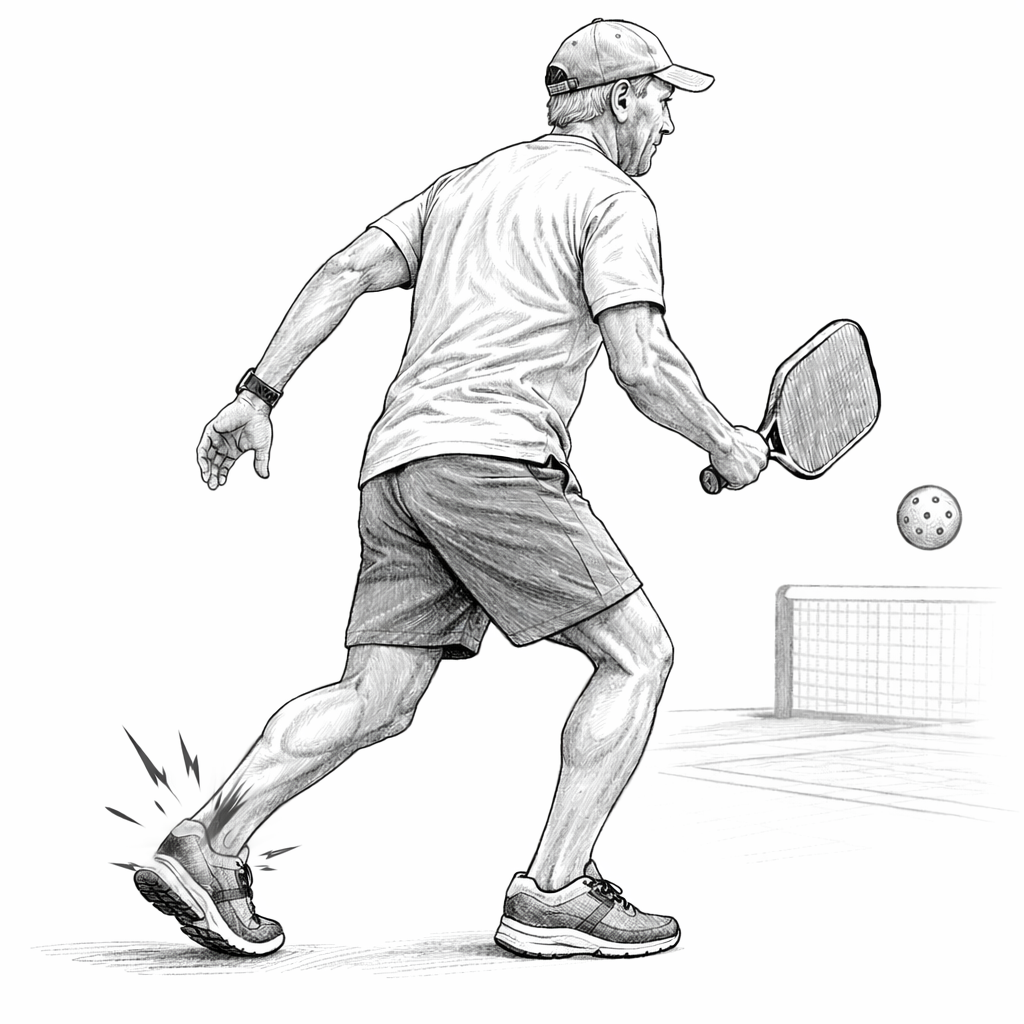
Pickleball Achilles Injury
In This Guide
This guide covers everything from diagnosis to returning to sports after an Achilles tendon rupture.
What Is an Achilles Tendon Rupture?
Signs and Symptoms
Can a Torn Achilles Heal on Its Own
Surgical vs. Non-Surgical Treatment
Achilles Rupture Recovery Timeline
Walking Boot Phase: What You Can and Can't Do
When Can You Walk, Run, and Play Sports Again?
Common Mistakes That Slow Recovery
Why Physiotherapy is Critical After an Achilles Rupture?
When Should You Start Physiotherapy?
Download Our Free Achilles Rehabilitation Protocol
1. What Is an Achilles Tendon Rupture?
The Achilles tendon connects the calf muscles to the heel bone and plays an essential role in walking, running, and pushing off the foot. Because we rely on it so heavily , it is one of the tendons most prone to injury. A torn Achilles tendon can be very scary, because it often happens suddenly during sports, exercise, or even a simple misstep.
An Achilles tendon injury can vary in severity. In general, there are two main types of Achilles tears or ruptures:
Partial tear: The tendon is damaged but not completely torn. However, larger partial tears (i.e.: 85%+) are often treated similarly to a full rupture.
Complete rupture: The tendon tears completely, separating the two ends of the tendon.
Common causes of Achilles ruptures
Achilles ruptures usually happen during quick explosive movements that overload the tendon. Common causes include:
Sudden push-offs during sprinting or lunging
Quick direction changes in sports like basketball, soccer, or pickleball (often called the “dreaded step back”)
Forceful jumps or landings
Sudden increases in activity, especially after a period of inactivity
Many people describe the injury as feeling like someone kicked them in the back of the leg, even though no one was there.
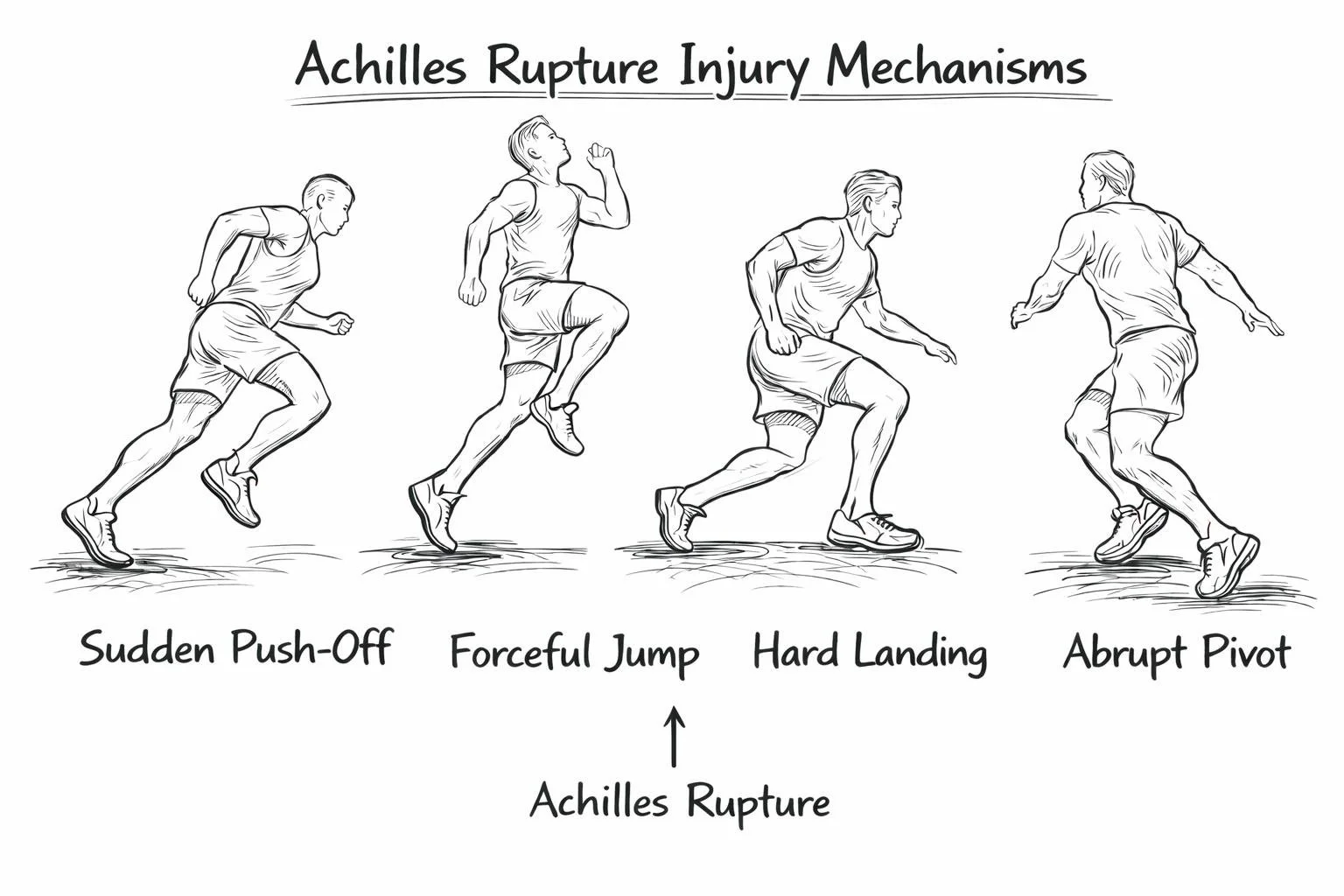
The Achilles tendon is incredibly strong—but sudden push-offs, hard landings, and quick pivots can sometimes ask more of it than it can handle.
2. Signs and Symptoms of a Torn Achilles
Common signs of an Achilles tendon tear include:
Sudden pain (or no pain) in the back of the ankle or heel
A popping or snapping sensation during injury
Feeling like being kicked in the calf
Swelling, stiffness or bruising around the ankle
Difficulty walking or pushing off the foot
Trouble standing on tiptoes or doing calf raises
Palpable gap or indentation in the tendon above the ankle
Positive Thompson test (i.e.: no movement of the foot when the calf is squeezed)
One thing that surprises many people is that a complete Achilles rupture isn't always extremely painful. So don't use pain as your guide. If you think you've torn your Achilles, get it assessed as soon as possible.
3. Can a Torn Achilles Heal on Its Own?
Short answer? Yes, as long as professional treatment is involved to ensure proper healing and long-term function. If left untreated, the tendon may heal in a stretched or lengthened position, which can lead to long-term problems such as reduced strength, difficulty walking, and a higher risk of re-rupture.
Achilles tendon tears can be partial or complete. Partial tears may still allow the tendon to function to some degree, but are at risk of tearing fully. A complete rupture means the tendon has fully torn.
A torn Achilles tendon can heal with or without surgery, but it is crucial that treatment begins in a timely manner. Regardless of the treatment approach, early diagnosis and rehabilitation are key to recovery.
Current research supports early weight bearing (within 2–3 weeks of injury) and functional rehabilitation after an Achilles rupture. In our experience at 416 Physio, patients who begin physiotherapy within the first 3 weeks and follow a structured program tend to recover strength and mobility more effectively.
While recovery timelines vary, full rehabilitation after an Achilles rupture typically takes 6–12 months.
If you are interested in reading more about this question, read our blog “Can a Torn Achilles Heal on Its Own”.
4. Achilles Rupture Treatment Options
Treatment for an Achilles tendon rupture usually comes down to two options: surgical or non-surgical management. For many people, this can feel like the most overwhelming part of the injury—like you’re making a big decision with long-term consequences.
The good news is that both approaches can lead to excellent outcomes when combined with a well-constructed rehabilitation program.
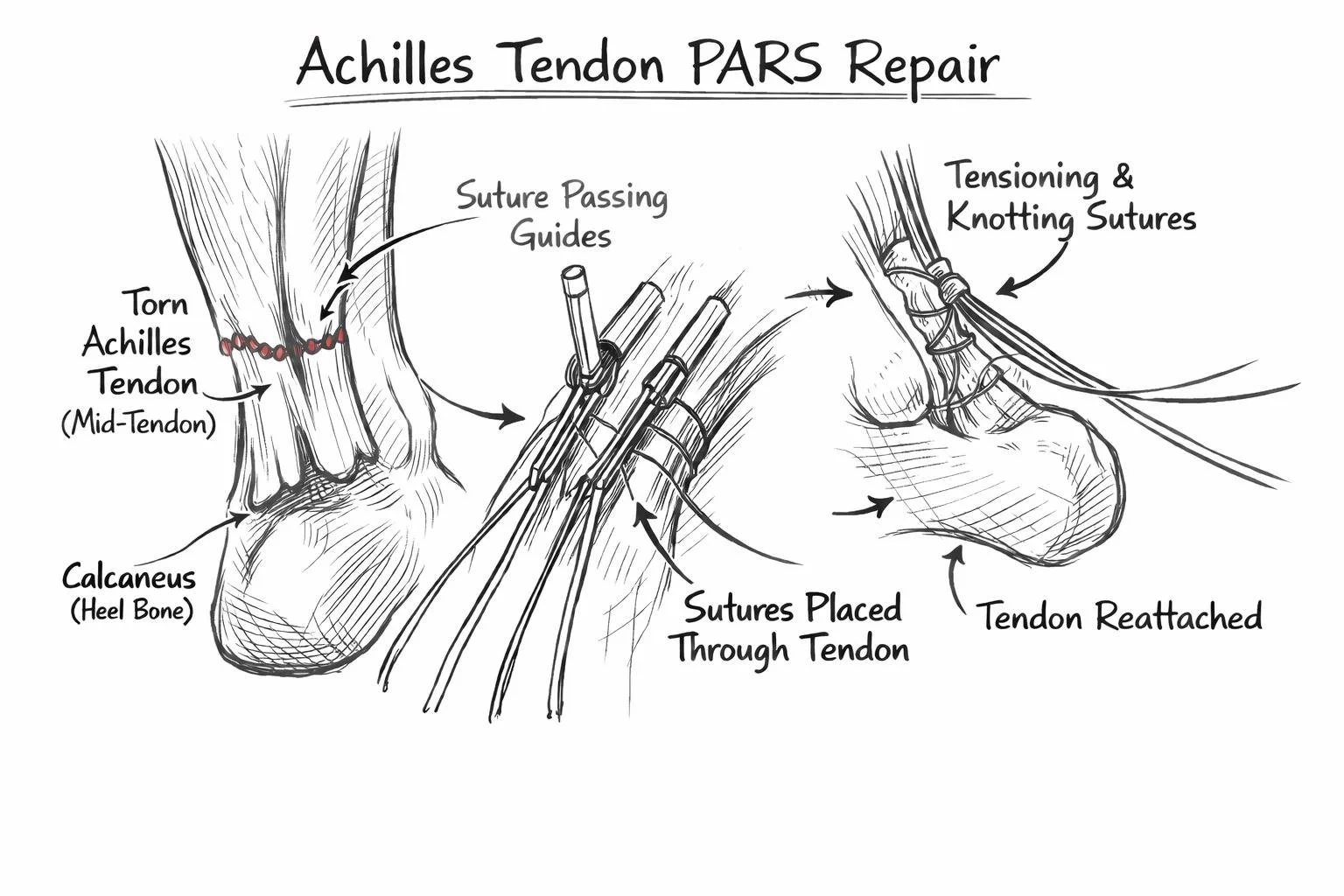
The PARS (Percutaneous Achilles Repair System) technique is a minimally invasive surgical procedure used to repair Achilles tendon ruptures through small incisions.
Surgical Treatment
Surgical repair involves reconnecting the torn ends of the Achilles tendon. It may allow for slightly shorter periods of immobilization, but like any surgery, it also comes with potential risks such as infection, nerve irritation, or wound complications.
There are several ways to repair an Achilles rupture, and the technique your surgeon recommends depends on factors such as where the tendon tore, the condition of the tendon, and how much time has passed since the injury. For the more common ruptures that occur a few centimetres above the heel (the mid-portion of the tendon), surgeons may choose either a traditional open repair or a minimally invasive technique such as the PARS (Percutaneous Achilles Repair System).
Timing matters. Minimally invasive procedures are typically performed within the first 2–3 weeks after injury. If you're unable to see a foot and ankle specialist during that time, some surgical options may no longer be available. Similarly, certain ruptures—especially those that occur higher up near the muscle (the musculotendinous junction)—may not be suitable for surgery at all.
What About the SpeedBridge Procedure?
You may have heard of the SpeedBridge technique after NFL quarterback Aaron Rodgers underwent Achilles surgery. It certainly put the procedure in the spotlight. However, it's important to know that SpeedBridge isn't the standard operation for most Achilles ruptures. It's primarily used for injuries where the tendon tears away from the heel bone (an insertional rupture or avulsion), rather than the more common mid-tendon rupture that occurs a few centimetres above the heel.
Non-Surgical Treatment
Non-surgical management typically involves wearing a walking boot with heel wedges or a VACOPed boot to keep the tendon in a shortened position and avoid early lengthening while it heals. Patients gradually progress to weight bearing and rehabilitation exercises as recovery moves forward.
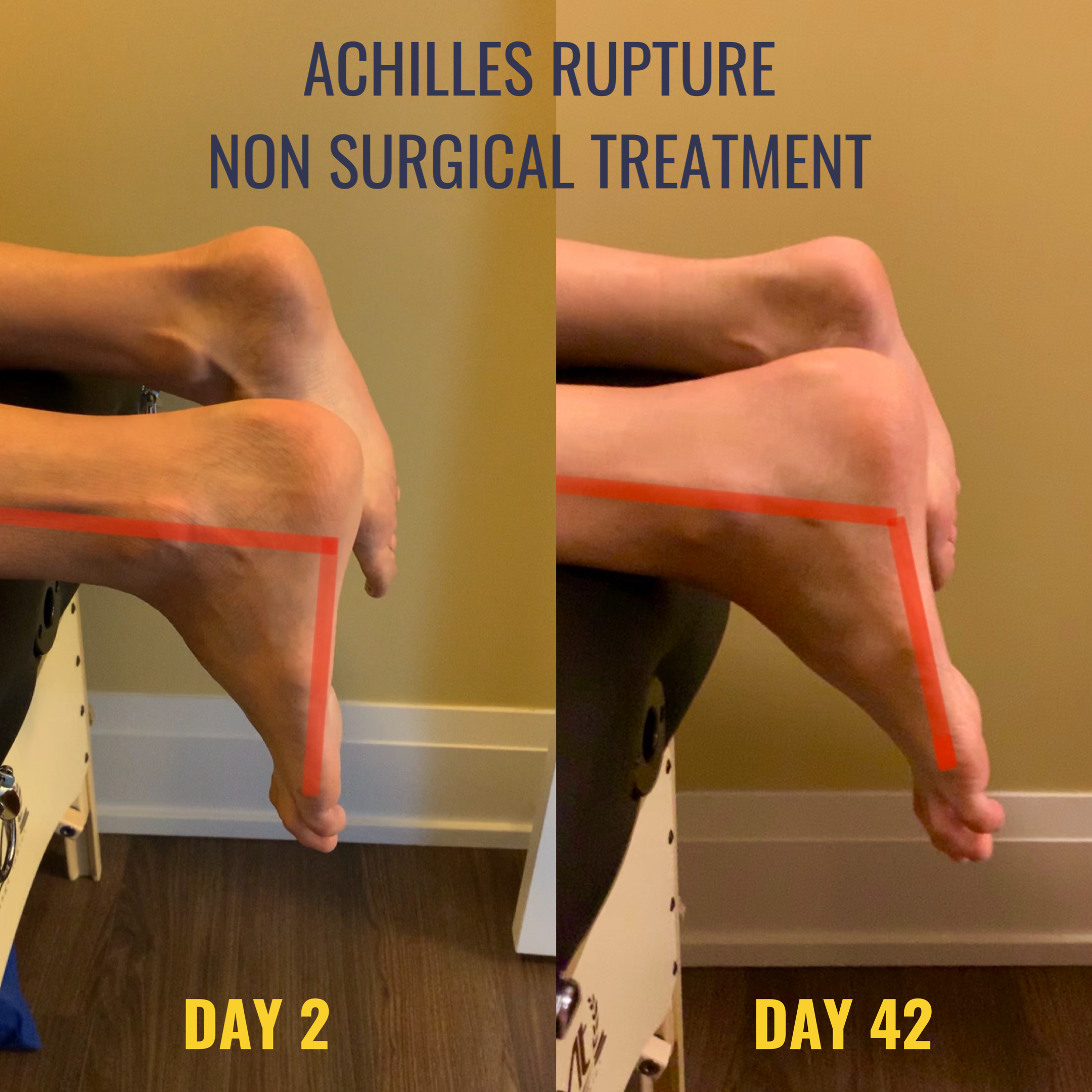
When the foot is placed in a boot with the foot pointed down, it allows the tendon to heal in a shortened position. We need a short tendon for optimal calf muscle recovery.
In the past, lengthy, strict immobilization was common. Fortunately, rehabilitation has evolved quite a bit since then. Modern research shows that both surgical and non-surgical approaches can lead to similar outcomes when paired with early functional rehabilitation.
Many current protocols now include early weight bearing, which helps stimulate healing and supports a faster return to activity. If you’re curious about how that works, we’ve covered it in more detail in our article on Early weight bearing after an Achilles rupture.
If you are interested in learning more about the surgical vs non-surgical methods, we wrote more about it in our blog Can a Torn Achilles Tendon Heal on Its Own?
5. Achilles Rupture Recovery Timeline
Recovering from an Achilles tendon rupture is a long process, and full functional recovery often takes about 12 months (unless you are Jayson Tatum who is young and has all the resources in the world and able to get back on the court after 10 months). That said, many patients reach important milestones much earlier along the way.
Recovery timelines can vary depending on factors such as the severity of the injury, age, overall health, and the type of rehabilitation program. It’s natural to compare your progress to others, but this often leads to unnecessary frustration.
With modern accelerated rehabilitation protocols, many people can safely return to activity earlier without increasing the risk of re-rupture.
The table below outlines a typical recovery timeline and rehabilitation milestones.
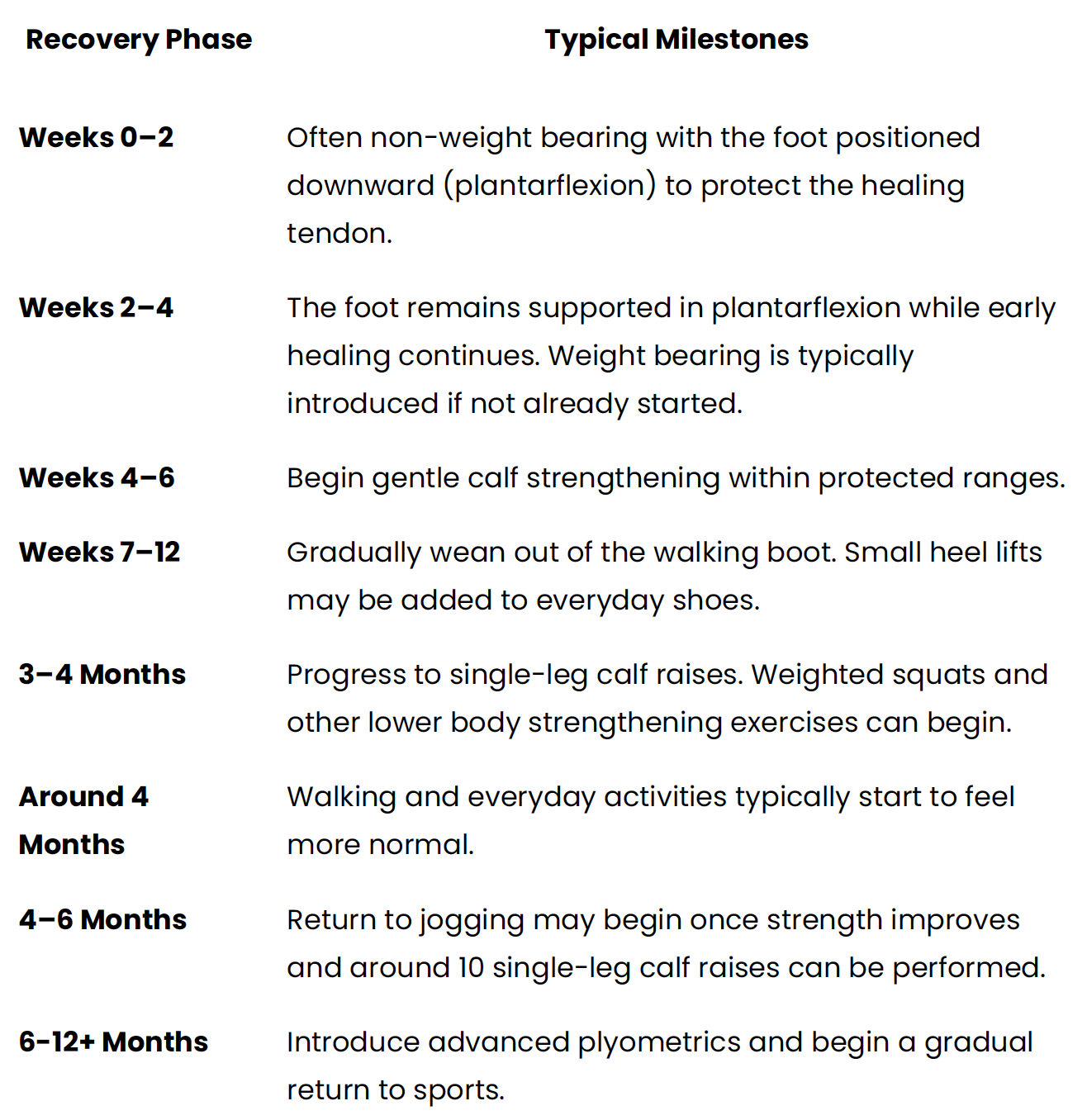
One thing we noticed is that many rehabilitation protocols stop just as recovery starts getting interesting. They provide good guidance during the first 12–16 weeks but offer very little direction after that. That's why we developed our own comprehensive Achilles rehabilitation protocol, with clear progressions to help guide both clinicians and patients through the entire recovery process. You can download it free at the end of this article.
If you’d like to learn more about the different phases of rehabilitation, check out our detailed guide on theAchilles rupture recovery timeline.
6. Walking Boot Phase: What You Can and Cannot Do
While the walking boot isn't exactly the most fashionable accessory, it has one very important job: protecting the healing tendon while allowing you to start moving safely.
Modern Achilles rehabilitation is no longer about keeping the ankle completely still for weeks. Research now supports early weight bearing and functional rehabilitation, provided the tendon is adequately protected during the early stages of healing.
Why Heel Lifts Matter
The purpose of the walking boot isn't simply to make walking easier. It's to position the foot in plantarflexion (toes pointing downward) so the torn ends of the tendon stay close together while they heal.
One thing we commonly see is rehabilitation protocols starting with only a 2 cm heel lift. In our opinion, that's simply not enough.
At 416 Physio, we typically recommend 5–6 cm of total heel lift (20- 30° of plantarflexion) during the first few weeks after injury. This helps maintain the tendon in a more shortened, protected position during the early stages of healing, reducing unnecessary tension on the healing tissue and helping minimize early tendon lengthening. One of the hardest things to regain after an Achilles rupture is calf strength—and if the tendon heals longer than it should, rebuilding that strength becomes much more difficult.
VACOped vs. a Conventional Walking Boot
Another question we hear all the time is:
"Do I need a VACOped boot?"
The honest answer is no. Plenty of people recover successfully in a conventional walking boot.
That said, if it's available, it's our preferred choice for most Achilles ruptures—especially if you're being treated without surgery.
Unlike a conventional walking boot, which relies on stacked heel wedges, the VACOped was specifically designed for Achilles tendon ruptures. It allows the ankle to be positioned in a controlled amount of plantarflexion while making it easy to gradually adjust the position as the tendon heals.
For patients following a non-surgical rehabilitation program, this is particularly important because the tendon isn't being stitched back together. During those first few weeks, one of the primary goals is to help maintain the tendon in a shortened, protected position while the torn ends begin to heal together. In our experience, the VACOped does this better than a conventional walking boot with a plateau-style heel lift.
We've also worn both ourselves.
Neither boot is particularly comfortable—you probably won't be making any fashion statements—but the VACOped is noticeably more comfortable to walk in, easier to adjust throughout rehabilitation, and simply feels like it was designed for this injury.
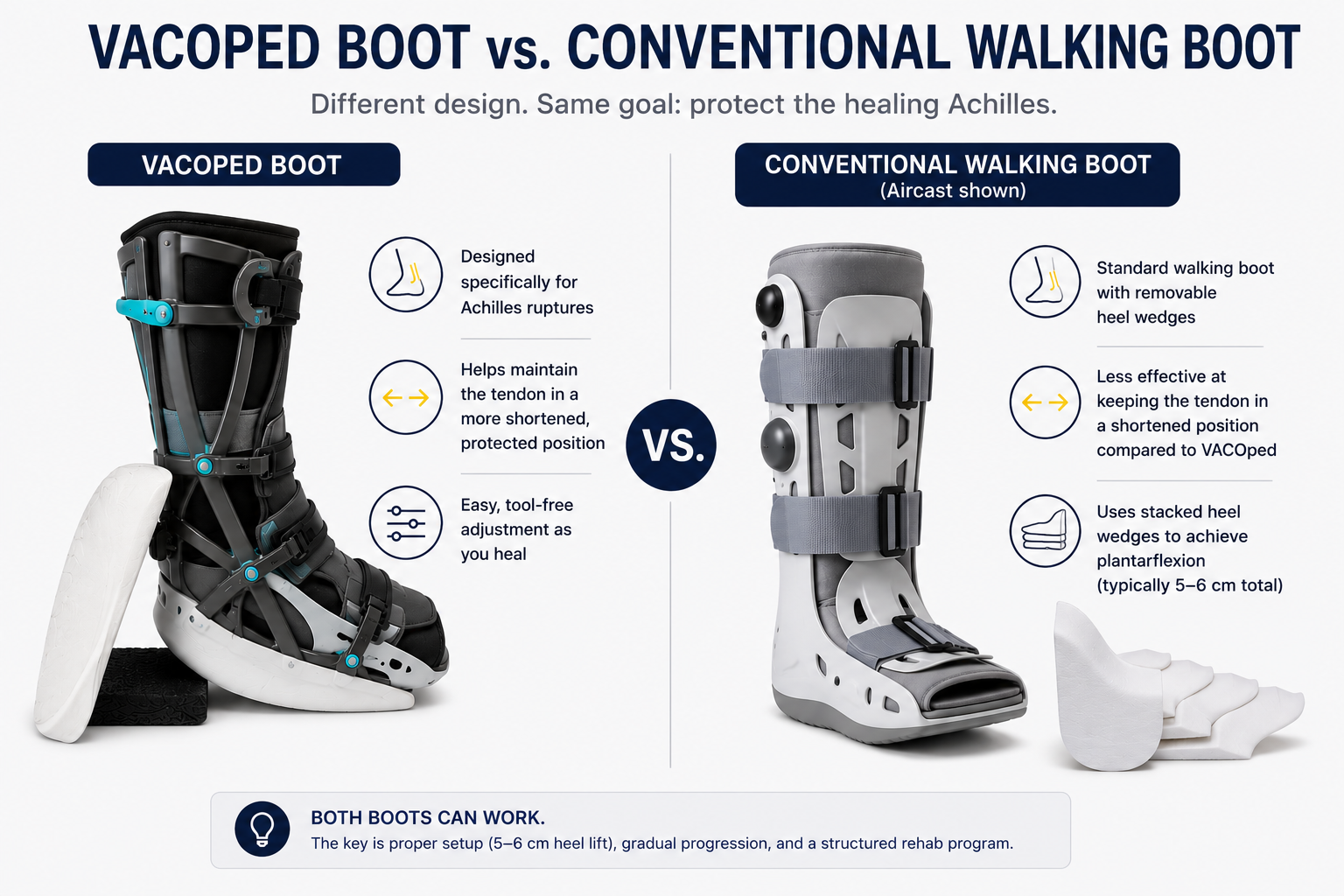
Comparison of a VACOped boot and a conventional walking boot with heel wedges. Both can achieve excellent outcomes when set up correctly, but we generally prefer the VACOped for Achilles rupture rehabilitation—especially during non-surgical recovery.
Don't Rush the Walking
One of the biggest milestones in recovery is transitioning out of the walking boot—but it's also one of the easiest stages to overdo.
It's natural to think, "I can walk now, so I should walk more." Unfortunately, the calf muscles are still weak and the tendon is still healing. Increasing your walking too quickly often leads to a weak push-off, limping, and an uneven walking pattern. It can also irritate the healing tendon, causing your body to compensate and making it even harder to regain a normal gait.
The goal isn't to walk more.
It's to walk better.
Gradually increasing walking while restoring proper calf function gives the tendon the best chance to heal at the correct length and prepares it for the next stages of rehabilitation.
Want to know what exercises are safe while you're still in the boot? Read our guide on What Exercises Can You Do in a Walking Boot?
Curious why early weight bearing is now recommended after an Achilles rupture? Learn more in our article on Achilles Rupture Early Weight Bearing.
7. Physiotherapy After an Achilles Rupture
Physiotherapy doesn’t just help the tendon heal—it helps ensure it heals strong enough to handle the demands of real life and sport, while reducing a risk of re-rupture and tendon lengthening. Working with a physiotherapist experienced in treating Achilles ruptures can make a major difference in recovery.
Why is physiotherapy essential after an Achilles rupture?
An experienced physiotherapist will:
Begin gentle mobilization and calf strengthening early, often even before you fully transition out of the walking boot. This helps reduce early tendon lengthening and muscle loss.
Re-train your walking pattern, helping the calf muscles engage properly as you return to normal walking.
Rebuild calf strength progressively, based on your individual goals and the demands of your sport or daily activities.
Restore ankle mobility, which is often limited after immobilization.
Strengthen other key muscle groups—including the foot, thigh, and hips—to support the entire movement chain during higher-level activities.
Gradually progress loading, introducing heavier calf raises, plyometrics, and explosive movements as the tendon adapts.
Prepare you for real-life demands, using sport-specific drills and movements to safely return to activity.
Support you throughout the entire rehab process, acting as both a guide and your biggest cheerleader—especially on the days when progress feels slow and the mood is low.
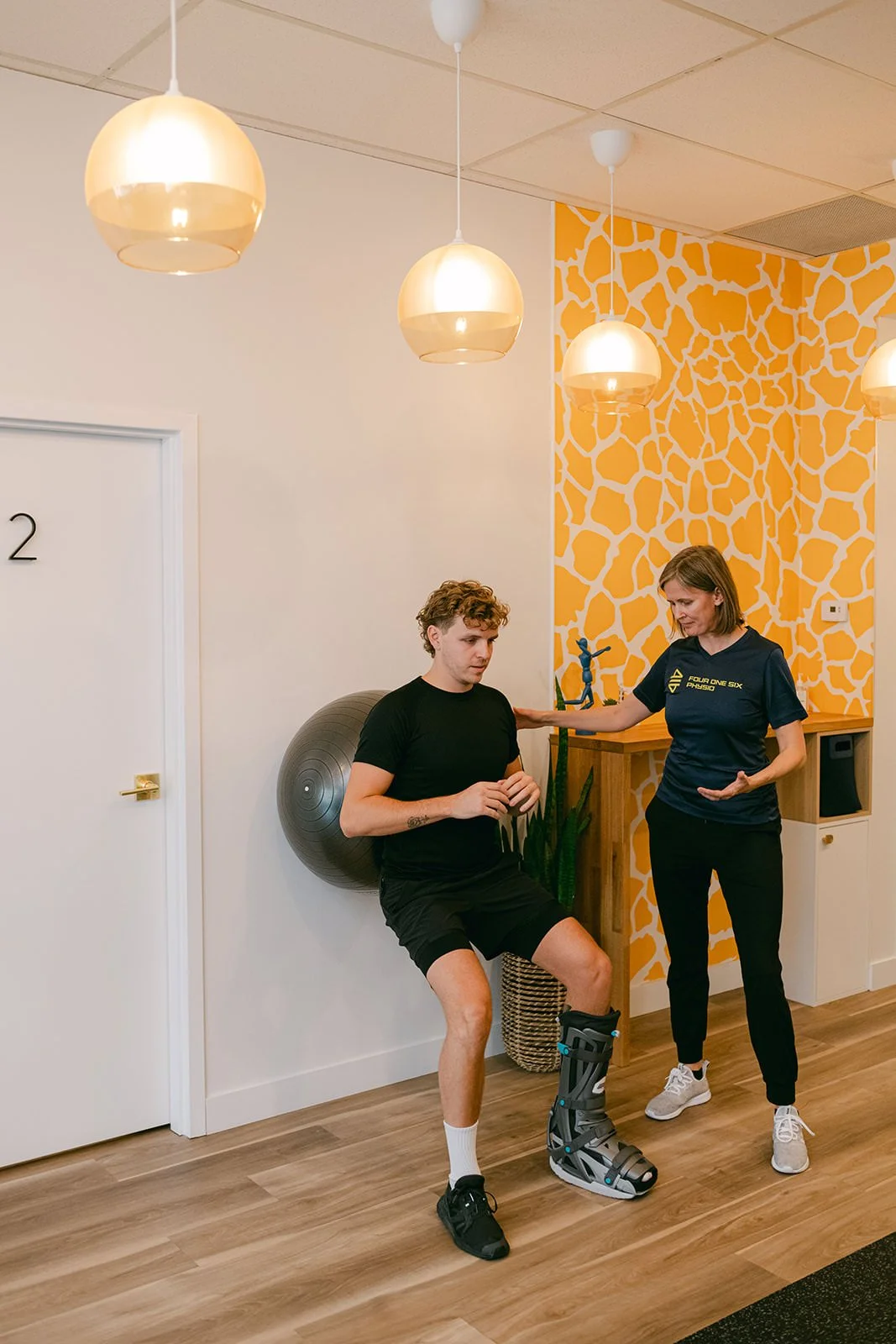
Early physiotherapy after an Achilles rupture focuses on restoring strength, protecting the healing tendon, and gradually progressing toward normal walking and everyday activities.
At 416 Physio, our Achilles rehabilitation program follows these principles at every stage of recovery—from early mobility and strength work to advanced plyometrics and return-to-sport testing.
Learn more about our Achilles physiotherapy program at 416 Physio.
8. When Can You Walk, Run, and Play Sports Again?
This is probably the most common question we get after an Achilles rupture.
"When can I walk normally?"
"When can I start jogging?"
"When can I play sports again?"
The honest answer is... when your tendon is ready.
Recovery can feel frustratingly slow at times. You'll probably have weeks where you feel like nothing is changing, followed by a week where everything suddenly gets easier. That's normal. Tendons heal on their own timeline, and unfortunately, there's no shortcut.
Here's a general idea of what most people can expect:
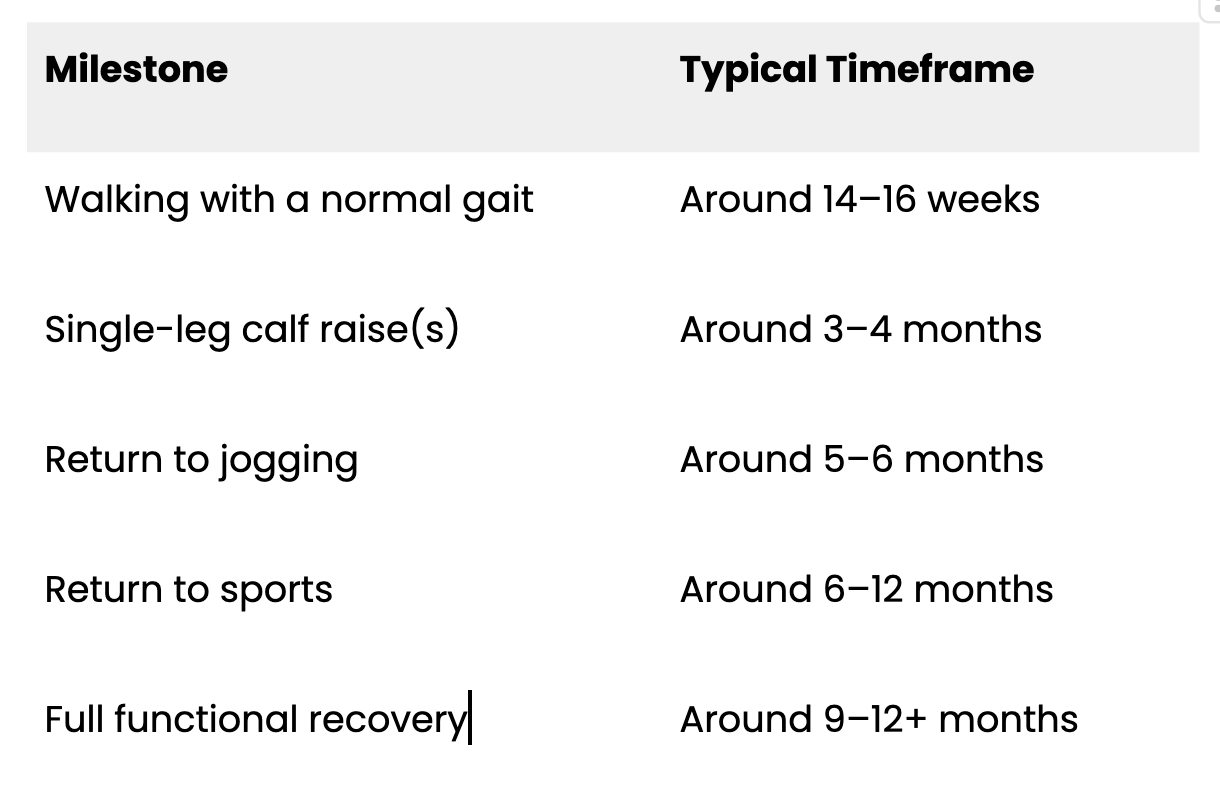
Typical recovery milestones after an Achilles tendon rupture. These timeframes are general guidelines—progress should always be based on tendon healing, strength, and function rather than time alone.
These are general guidelines—not deadlines. Some people move a little faster, while others need more time. Your age, overall health, treatment approach, tendon healing, and commitment to rehabilitation all play a role.
If you're looking for a more detailed breakdown of each phase, check out our Achilles Rupture Recovery Timeline article.
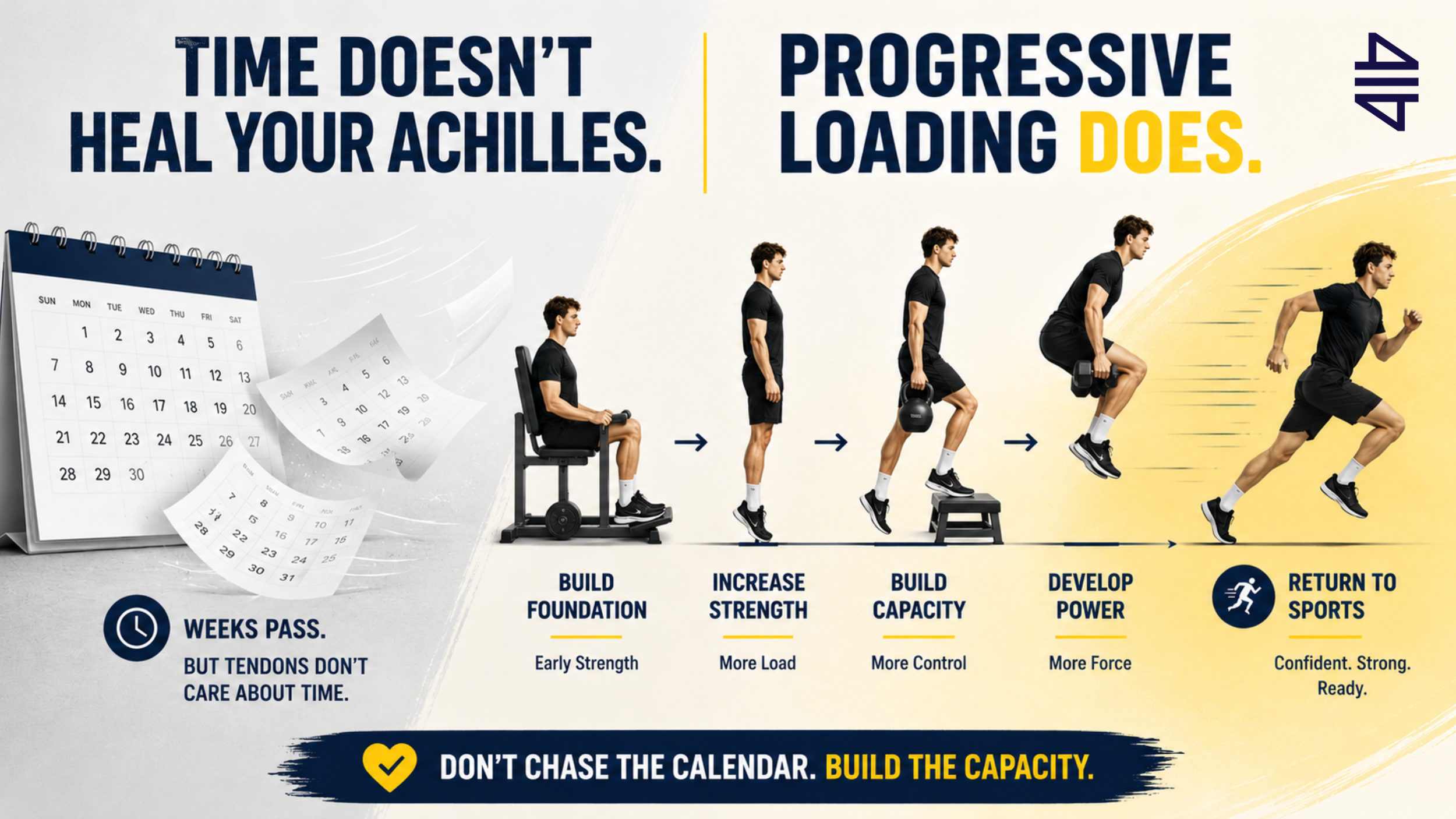
Successful Achilles rehabilitation isn't about waiting for time to pass—it's about progressively rebuilding strength, capacity, and power. Each stage prepares the tendon for the next, from early calf strengthening to a safe return to running and sports.
Don't Chase the Calendar
One of the biggest mistakes we see is people progressing simply because the calendar says they should.
Don't progress because time has passed—progress because your tendon is ready.
Being able to jog isn't about reaching five months. It's about having enough calf strength, tendon capacity, balance, and control to handle the forces of running safely. The same goes for jumping, cutting, and returning to sports.
At 416 Physio, we don't base progression on time alone. We combine your symptoms with strength testing, functional assessments, and, when appropriate, force plate testing to make sure you're actually ready for the next stage.
Your recovery isn't a race. The goal isn't to be first—it's to get back once, and get back well.
Recovery Isn't Just Physical
One thing we haven't talked about yet is the mental side of recovery.
An Achilles rupture doesn't just take away your ability to run or play sports—it often takes away your routine, your stress relief, your social life, and sometimes even a part of your identity. It's completely normal to feel frustrated, impatient, or worried about whether you'll ever get back to where you were.
In fact, many people tell us the mental side of recovery is harder than the physical rehabilitation itself.
If that's something you're experiencing, you're definitely not alone. We recently partnered with registered social worker and psychotherapist Meg Pirie to explore the emotional side of injury recovery, including fear of re-injury, motivation, and coping with the ups and downs of a long rehabilitation journey.
Read our guest article: The Mental Side of Sports Injury Recovery
9. Common Mistakes That Slow Achilles Recovery
Recovering from an Achilles tendon rupture takes time and a carefully guided rehabilitation plan. Certain mistakes can slow progress or increase the risk of complications. Here are some of the most common ones we often see at our clinic (in no particular order):
Mistake 1: Poor walking mechanics
Transitioning out of the walking boot is one of the most challenging stages of Achilles rehabilitation. At this point the tendon is still healing, and progressing too quickly can increase the risk of re-rupture or the tendon healing in a lengthened position.
Increasing walking volume too quickly often leads to weak push-off and an uneven walking pattern, because the calf muscles are not yet strong enough. Doing too much too soon can also irritate the tendon, causing your body to change the way you walk to protect the injury. Gradual progression and proper walking mechanics are key during this stage.
Mistake 2: Returning to activity too early
Just because Jayson Tatum can return to the NBA in 10 months, it doesn’t mean that you can play pick up sports 10 months after your rupture. It’s tempting to get back to normal activities quickly, especially once pain starts to improve.
However, pushing the tendon too hard too early can increase the risk of re-rupture or delayed healing. Progression should be based on strength and function—not just time. The use of force plates can give us much needed objective information about your readiness to return to sports.
Mistake #3: Skipping physiotherapy (or not listening to your physio…)
Yes, there are a lot of calf raises. But do you know that we do 28+ different variations? A proper program goes beyond single-leg calf raises, and also targets other important muscles that support the ankle and leg.
Mistake #4: Stopping rehab too early
Many people feel much better around 4 months and assume recovery is complete. It is true that most activities that you do during your day are much easier. However, full tendon healing and strength restoration often take 9–12 months, and stopping rehabilitation too soon can leave the tendon vulnerable.
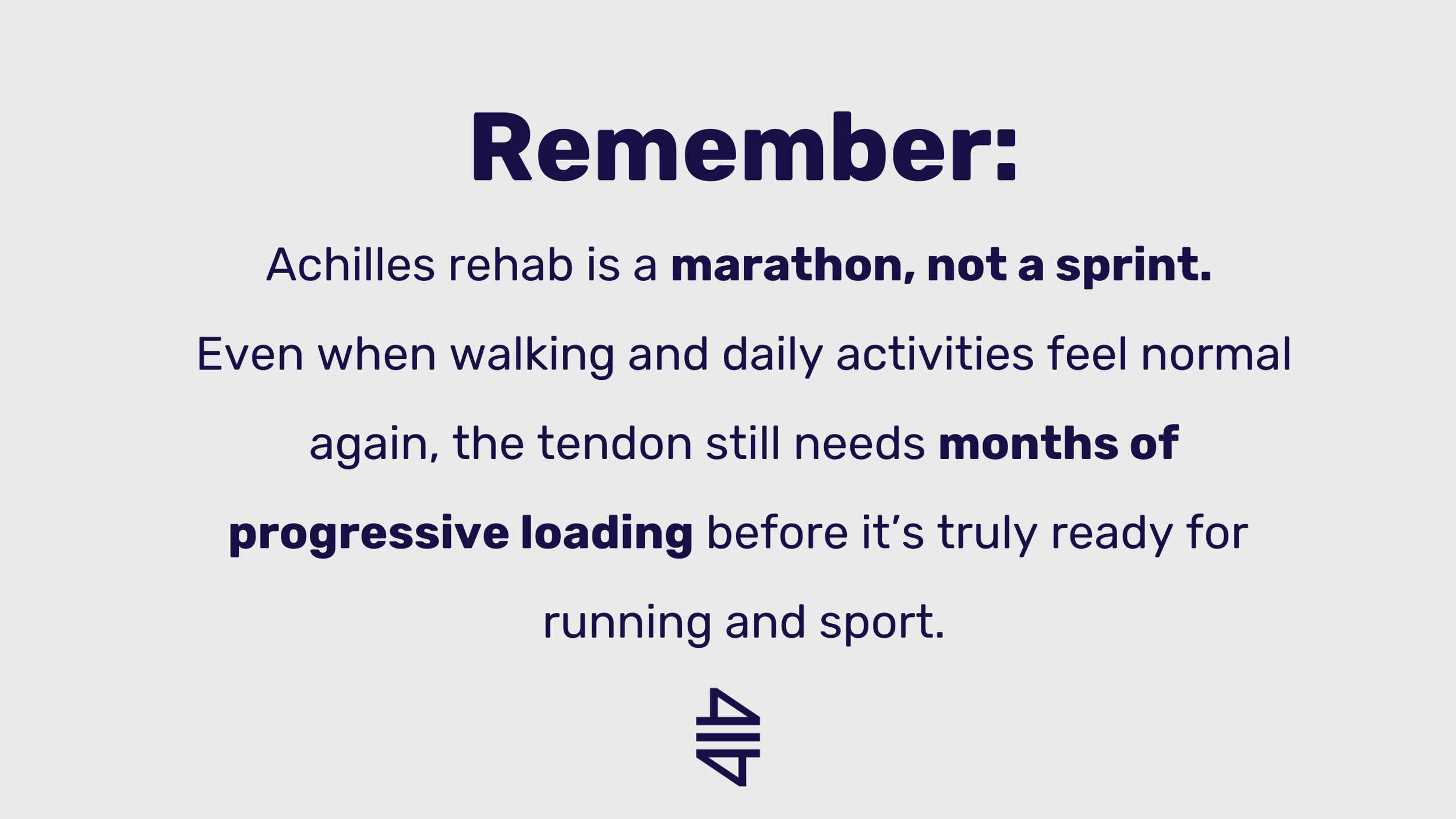
Feeling "normal" doesn't mean your Achilles has fully healed. Even after walking becomes easy again, the tendon still needs months of progressive loading to safely return to running and sport.
Mistake #5: Ignoring swelling or pain
Nearly everyone tests the limits of their healing tendon at some stage of rehab. Learning when to ease off is part of the process. Mild discomfort can be normal, but persistent swelling or pain is often a sign that the tendon is being overloaded. Adjusting activity levels and overall load can help prevent big setbacks.
Mistake #6: Underloading calf raises
This is one of the biggest mistakes healthcare professionals make when they are not familiar with treating Achilles ruptures. During running and jumping movements the tendon needs to handle forces up to 6-12x the body weight. Doing 3x10 body weight single leg calf raises just won’t cut it.
Mistake #7: Missing out on targeting explosive strength training
Later stages of rehab should gradually introduce faster and more dynamic exercises, such as jumping, hopping, and plyometrics. These movements help the tendon relearn how to store and release energy quickly, which is essential for safely returning to sports and higher-level activities.
Mistake #8: Trying to Stretch Your Way Back
If you've ever thought, "My Achilles feels tight, I should stretch it," you're not alone.
After an Achilles rupture, that feeling of tightness is often a normal part of healing—not a sign that you need to stretch harder. In the early stages, the tendon needs to regain strength and capacity, not extra length. Too much stretching too soon may even work against you. Build the strength first, and the mobility usually follows.
10. Why Physiotherapy Is Critical for Achilles Recovery
Yes, you could try using ChatGPT to guide your Achilles rehabilitation. But even AI can’t fully replace the guidance of an experienced physiotherapist—especially when new questions, setbacks, or concerns arise during a long recovery.
Consistent rehabilitation guided by a physiotherapist improves several important recovery outcomes. This structured, progressive approach is the foundation of the Achilles rehabilitation program we use at 416 Physio. To make these outcomes easier to understand, we’ve summarized them in the table below.
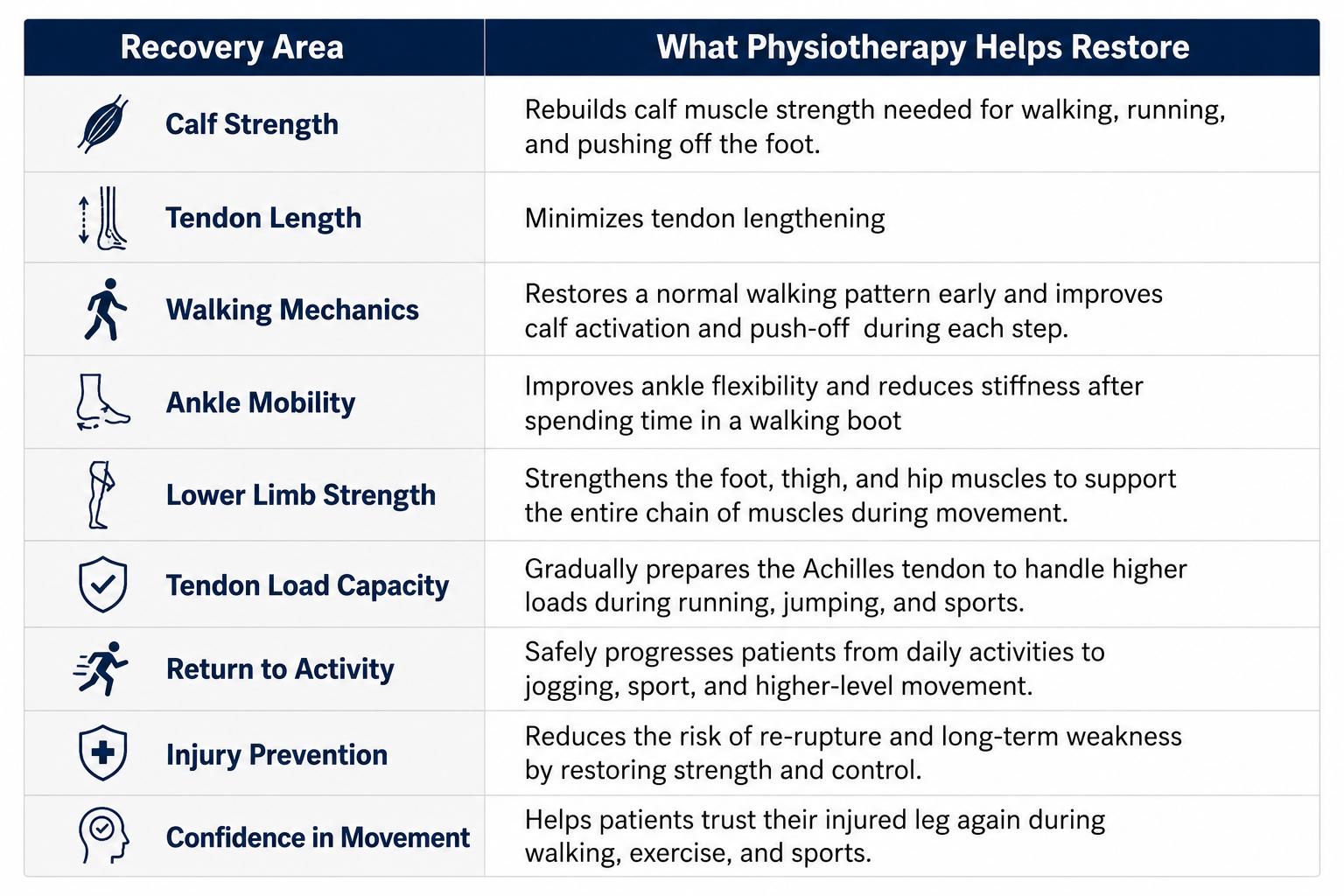
Physiotherapy after an Achilles rupture goes far beyond calf raises. A comprehensive rehabilitation program restores strength, walking mechanics, tendon capacity, confidence, and safely prepares you to return to running and sports.
11. Achilles Rupture Physiotherapy at 416 Physio
Treating Achilles tendon tears requires experience and precision as there is very small room for error. At 416 Physio our physiotherapists have the expertise to guide you along this rather difficult journey.
Why Choose 416 Physio?
We've successfully treated hundreds of Achilles tendon ruptures.
Individualized rehabilitation programs based on your tendon's current function and goals.
Progressive loading programs to help you safely return to running and sport.
Early gait retraining to minimize tendon lengthening and maximize push-off strength.
Return-to-sport testing and objective performance tracking using force plates.
Milestone-based rehabilitation—not progression based on the calendar alone.
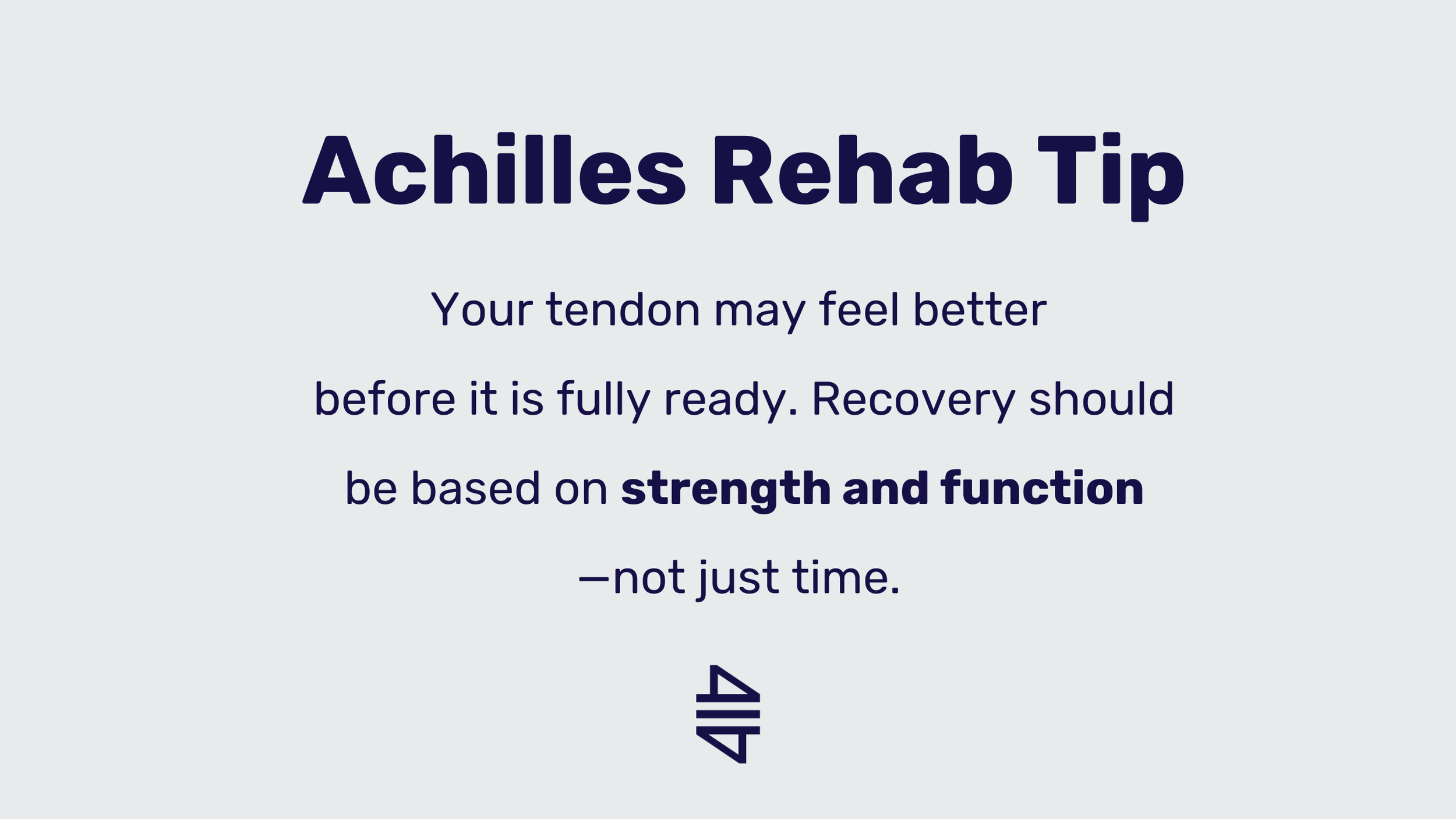
Your Achilles may feel better before it's fully healed. Progress your rehabilitation based on strength, function, and tendon capacity—not just the number of weeks since your injury.
If you’ve experienced an Achilles tendon rupture, our physiotherapists at 416 Physio can guide you through every stage of recovery. Discover our Achilles rupture program or book an appointment with us below.
12. When Should You See a Physiotherapist?
You don't need to see a physiotherapist three days after your Achilles rupture. Once your diagnosis has been confirmed and you've discussed surgery versus non-surgical treatment with your specialist, it's a good idea to get started. Most people begin physiotherapy within 2–3 weeks after the injury (or after surgery, if surgery is performed).
A physiotherapist can help you:
Set up your walking boot correctly and adjust heel wedges as you recover.
Start safe exercises to maintain strength and mobility.
Progress weight bearing at the right pace.
Rebuild calf strength without overloading the healing tendon.
Prepare you for walking, running, and eventually returning to sports.
The earlier you start, the easier it is to avoid common setbacks later in recovery.
It Might Be Time for a Second Opinion If...
Not every physiotherapist regularly treats Achilles ruptures. That's okay—it's a fairly specialized injury. But if your rehabilitation isn't progressing, it may be worth getting another opinion.
Some signs your rehabilitation may need a fresh set of eyes include:
You're several months into rehab and you're still doing the same body-weight calf raises.
Your treatment focuses mostly on massage, ultrasound, laser, dry needling, or other passive treatments, with very little progressive strengthening.
You're unsure why you're doing certain exercises or what the next stage of rehab looks like.
Progression is based only on the calendar, rather than your strength and function.
You haven't discussed running, jumping, or return-to-sport testing.
A successful Achilles rehabilitation program should evolve as you recover. Early rehab focuses on protecting the tendon. Later rehab should become progressively heavier, faster, and more sport-specific.
At 416 Physio, we guide patients from the first days after injury all the way through return to running and sport using progressive strengthening, functional testing, and objective measures such as force plate assessments when appropriate.
The goal isn't just to heal your Achilles—it's to help you trust it again.
Recovering from an Achilles tendon rupture takes time, patience, and the right rehabilitation program. While the tendon will heal on its own, rebuilding the strength, confidence, and capacity to return to walking, running, and sports requires progressive rehabilitation.
Tendons heal with time. Strong tendons are built through proper rehabilitation.
Download Our Free Achilles Rehabilitation Protocol
If you'd like a practical roadmap to guide your recovery, download the rehabilitation protocol we developed at 416 Physio. It expands on many of the concepts covered in this article and includes:
Rehabilitation milestones
Walking boot progression
Strengthening progressions
Return-to-running and sport guidance
Enter your email below and we'll send the protocol straight to your inbox.

Need More Help?
Every Achilles rupture is different. If you've recently injured your Achilles—or you feel like your recovery has stalled—we'd be happy to help.
At 416 Physio, we've helped hundreds of people recover from Achilles ruptures using individualized, evidence-informed rehabilitation programs.
Ready to get started? Book an Achilles physiotherapy assessment online or give us a call.