

Feeling dizzy or off-balance can be frustrating, especially when you're not sure what's causing it. You might feel unsteady when turning your head, notice dizziness alongside neck pain or stiffness, or simply feel that something is “off.”
While dizziness is often associated with the inner ear, the neck can sometimes play a role too.
This is known as cervicogenic dizziness, a condition in which altered sensory information from the neck may contribute to feelings of dizziness or imbalance. In this article, we'll explain how the neck may contribute to dizziness, what symptoms to look for, and how assessment and rehabilitation can help.
What Is Cervicogenic Dizziness?
Our brain relies on three main sources of information to understand where our head and body are in space:
The visual system (eyes) tells us what we're seeing around us.
The vestibular system (inner ear) detects head movement and helps us maintain balance.
The proprioceptive system (neck) tells the brain where the head is positioned in relation to the rest of the body.
Normally, these three systems constantly communicate with one another, sending information that matches. For example, when you turn your head to the right, your eyes, inner ear and neck should all provide your brain with consistent information about that movement.
In people with suspected cervicogenic dizziness, the information coming from the neck may be altered or less accurate. This means the signals from the neck may not fully agree with the information coming from the eyes and inner ear. This mismatch, often called a sensory mismatch, may contribute to feeling off-balance, unsteady or disoriented, particularly during head movements.
Think of It Like a Television Connection
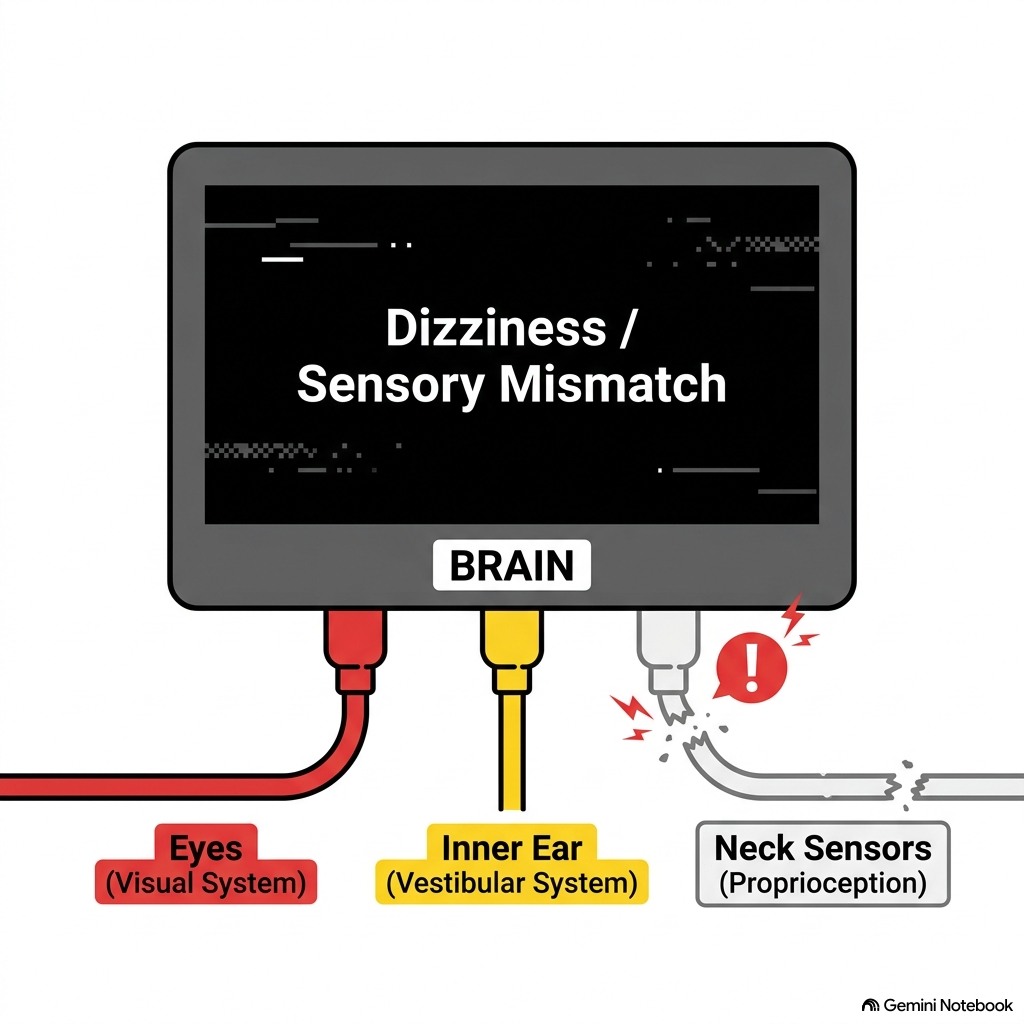
Just as a loose cable can disrupt a television’s picture, conflicting signals from the neck, eyes and inner ear may contribute to dizziness and feelings of imbalance.
A simple way to picture this is to think about the red, yellow and white cables traditionally used to connect a device to a television.
Imagine the TV is your brain. One cable represents your visual system, another represents your vestibular system, and the third represents the proprioceptive information coming from your neck.
When all three cables are connected properly and sending clear information, the television produces a clear picture and sound.
But imagine one cable becomes loose or starts sending an inaccurate signal. The television may still work, but the picture becomes distorted because the information isn't coming through correctly.
The same idea can help explain cervicogenic dizziness. If the information coming from the neck doesn't match what the brain is expecting, it may contribute to feeling unsteady or “off,” particularly when turning the head, looking around while walking, or holding the neck in certain positions.
What Does Cervicogenic Dizziness Feel Like?
Patients with suspected cervicogenic dizziness often describe their symptoms differently from someone experiencing traditional spinning vertigo.
They might say:
“I don't feel like the room is spinning. I just feel off when I turn my head.”
“When my neck gets really tight, I feel less steady.”
“My eyes and my head don't feel in sync.”
The experience can vary from person to person, but common features may include: [1,2,6]
Feeling unsteady or off-balance
Feeling disoriented or simply “off”
Neck pain or stiffness occurring alongside dizziness
Symptoms aggravated by certain neck movements or prolonged positions
Reduced or uncomfortable neck movement
Headaches occurring alongside neck symptoms
Difficulty with balance or coordination
Visual discomfort or difficulty maintaining a steady gaze during head movements
Symptoms following a neck injury or whiplash
Headaches can also occur alongside neck pain and dizziness. When the neck contributes to headache symptoms, this may be described as a cervicogenic headache. Learn more about the connection between neck pain and headaches in our blog, Why Your Headaches Keep Coming Back (And What Your Neck Has To Do With It).
Some people with whiplash injuries, neck stiffness, reduced cervical movement or persistent neck pain may also experience dizziness or imbalance. Pain and changes in neck movement can affect the proprioceptive information being sent from the cervical spine, potentially interfering with how the brain combines information from the neck, eyes and inner ear. [4,6]
The relationship between neck symptoms and dizziness is often more informative than any single symptom. For example, feeling dizzy when rolling over in bed without neck pain may suggest a different condition than someone whose unsteadiness consistently increases when their painful, stiff neck is aggravated.
However, these symptoms alone cannot confirm cervicogenic dizziness. A proper assessment is needed to investigate other possible causes.
Cervicogenic Dizziness vs Vertigo What's the Difference?
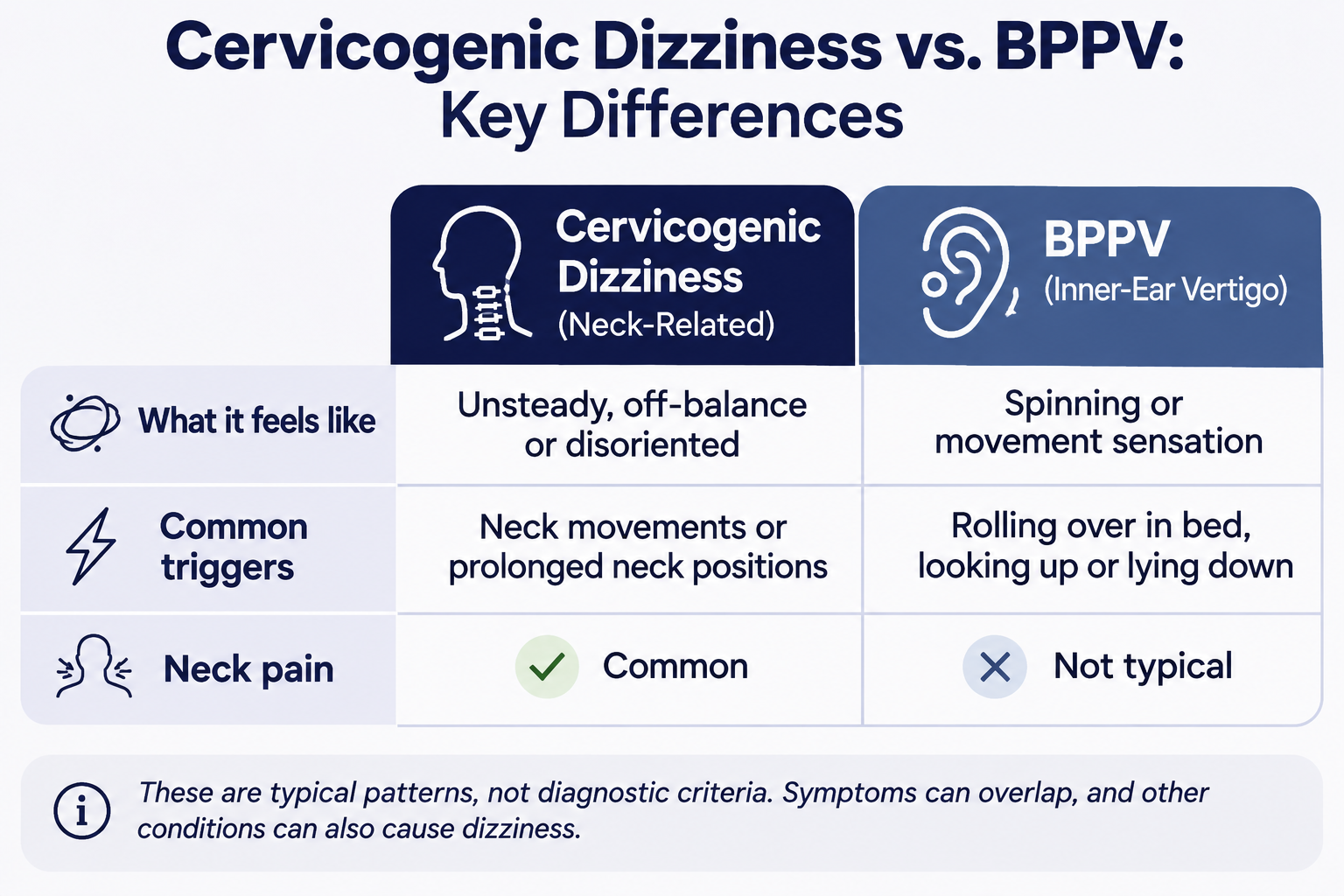
Cervicogenic dizziness and BPPV can cause similar symptoms, but their typical triggers and sensations differ. A thorough assessment can help identify the cause of your dizziness and guide appropriate treatment.
People often use the words dizziness and vertigo to mean the same thing, but there is an important difference.
Vertigo is a specific type of dizziness where you feel like you or your surroundings are spinning or moving, even though you're staying still.
Cervicogenic dizziness, on the other hand, is more often described as feeling off-balance, unsteady, lightheaded or disoriented rather than experiencing a true spinning sensation. It is commonly associated with neck pain or stiffness, and symptoms may worsen with certain neck movements. [1,3]
One common cause of vertigo is benign paroxysmal positional vertigo (BPPV), an inner-ear condition that can cause brief episodes of spinning when changing head position, such as rolling over in bed, looking up or getting out of bed.
Although the symptoms can sometimes overlap, the underlying causes and treatment approaches may be different. This is why a thorough assessment is important before assuming dizziness is coming from the neck.
Cervicogenic Dizziness Treatment at 416 Physio in Etobicoke
How We Assess Cervicogenic Dizziness
At 416 Physio, our approach to cervicogenic dizziness is rehabilitation-focused.
We begin with a thorough history and physical assessment to determine whether the cervical spine may be contributing to your symptoms. This includes evaluating neck movement, balance and coordination, while screening for other possible causes of dizziness that may require further assessment or referral.
One test we may use is the Joint Position Sense Error Test, demonstrated in the video below. This test helps us assess how accurately a patient can sense the position of their head and neck without relying on vision.
During the test, the patient wears a laser pointer attached to their head and attempts to return the laser to the centre of a target after moving their head with their eyes closed. By removing visual feedback, we can better assess the proprioceptive information coming from the neck.
Patients with a history of chronic neck pain may have more difficulty returning the laser accurately to the centre of the target. This can provide useful information about cervical proprioception and help guide rehabilitation. [2,4]
How We Treat Cervicogenic Dizziness
Treatment depends on what we find during your assessment. If the neck appears to be contributing to your dizziness, rehabilitation may include a combination of hands-on treatment, targeted exercises, balance training and strengthening.
Manual Therapy and Neck Mobility
Research suggests that manual therapy can help reduce dizziness and improve neck movement in some patients with cervicogenic dizziness. [7,8]
Treatment may include gentle joint mobilization and other hands-on techniques to improve movement in stiff or painful areas of the neck.
Proprioception and Balance Retraining
If the neck is having difficulty accurately sensing its position, we may use exercises to help retrain this system.
One example is using a laser or visual target while moving the head and then trying to return to the starting position. This helps improve awareness and control of neck position.
Head, Eye and Body Coordination
The eyes, head, neck and body all work together during normal movement. When these systems aren't coordinating effectively, certain activities may contribute to feelings of dizziness or unsteadiness.
Depending on your assessment, exercises may include:
Walking while gently turning your head
Keeping your eyes focused on a target while moving your head
Moving your eyes first, then following with your head
Turning your body while keeping your head steady
Practising balance in different positions
These exercises aim to improve coordination and help you feel more comfortable and confident during everyday movements.
Neck Strength and Endurance
Rehabilitation may also include exercises to strengthen the neck and upper-back muscles.
Improving strength and endurance can help support the cervical spine and increase your ability to tolerate prolonged positions and everyday activities.
When Dizziness Needs Medical Attention
Dizziness should never automatically be assumed to be coming from the neck. While cervicogenic dizziness may contribute to feelings of unsteadiness or imbalance, other conditions can cause similar symptoms.
Seek emergency medical attention if you experience sudden or severe dizziness accompanied by any of the following:
New weakness or numbness in the face, arm or leg
Difficulty speaking or understanding speech
Double vision or sudden significant changes in vision
New difficulty swallowing
Severe difficulty walking or coordinating movements
Fainting or loss of consciousness
A sudden, unusual or severe headache or neck pain
Chest pain or severe shortness of breath
Even without these warning signs, new, persistent or unexplained dizziness should be assessed by an appropriate healthcare professional rather than assuming it is coming from the neck.
Ready to Figure Out What Is Making You Dizzy?
If you're experiencing dizziness or unsteadiness alongside persistent neck pain or stiffness, a thorough assessment can help determine whether your neck may be contributing to your symptoms.
At 416 Physio in South Etobicoke, we provide evidence-based, rehabilitation-focused chiropractic care that combines hands-on treatment with targeted exercises to improve neck function, balance and coordination.
Your treatment plan is individualized based on your assessment findings, symptoms and goals. If another cause of dizziness is suspected, we'll help guide you toward appropriate further assessment.
Book an assessment with Dr. Sahib Gill to better understand what may be contributing to your dizziness and what you can do about it.
FAQs About Cervicogenic Dizziness
Can neck problems cause dizziness?
Yes, in some people, the neck may contribute to dizziness. Your neck sends information to your brain about head position and movement. If that information is altered, it may not match what your eyes and inner ear are telling your brain, potentially making you feel unsteady or “off.” Other possible causes of dizziness still need to be considered. [2–4]
What does cervicogenic dizziness feel like?
Cervicogenic dizziness is often described as feeling off-balance, unsteady, lightheaded or disoriented rather than experiencing a spinning sensation. It commonly occurs alongside neck pain or stiffness and may worsen with certain neck movements or positions. [1,2]
How do I know if my dizziness is coming from my neck?
There is no single test that can confirm cervicogenic dizziness. A thorough assessment considers your symptoms, neck movement, balance, eye and head coordination, and other possible causes of dizziness. [2]
What is the difference between cervicogenic dizziness and vertigo?
Vertigo is a sensation that you or your surroundings are spinning or moving when you're actually still. Cervicogenic dizziness is more commonly associated with unsteadiness or imbalance rather than spinning. Inner-ear conditions such as benign paroxysmal positional vertigo (BPPV) can cause similar complaints, so proper assessment is important. [1–3]
Can chiropractic treatment help cervicogenic dizziness?
Chiropractic rehabilitation may help some patients with suspected cervicogenic dizziness. Research suggests that manual therapy can reduce dizziness and improve neck mobility in certain patients. [7–9] At 416 Physio, treatment may also include exercises to improve balance, neck control, strength and coordination.
What exercises help cervicogenic dizziness?
Exercises depend on your assessment findings and may include balance training, head and eye coordination exercises, neck-position exercises, walking with head movements, mobility work, and strengthening for the neck and upper back. [4,5,7]
Related Readings:
Why Your Headaches Keep Coming Back (And What Your Neck Has to Do With It)
Learn how neck problems can contribute to recurring headaches and how targeted rehabilitation may help.
When Should You See a Chiropractor?
Not sure whether chiropractic care is right for you? Learn when a chiropractic assessment may be helpful and what to expect from treatment.
References
1. Wrisley, D. M., Sparto, P. J., Whitney, S. L., & Furman, J. M. (2000). Cervicogenic dizziness: A review of diagnosis and treatment. Journal of Orthopaedic & Sports Physical Therapy, 30(12), 755–766.
https://doi.org/10.2519/jospt.2000.30.12.755
2. Reiley, A. S., Vickory, F. M., Funderburg, S. E., Cesario, R. A., & Clendaniel, R. A. (2017). How to diagnose cervicogenic dizziness. Archives of Physiotherapy, 7, 12.
https://doi.org/10.1186/s40945-017-0040-x
3. Seemungal, B. M., Agrawal, Y., Bisdorff, A., Bronstein, A. M., Cullen, K. E., Goadsby, P. J., Lempert, T., Kothari, S., Lim, P. B., Magnusson, M., Marcus, H. J., Strupp, M., & Whitney, S. L. (2022). The Bárány Society position on ‘Cervical Dizziness’. Journal of Vestibular Research, 32(6), 487–499.
https://doi.org/10.3233/VES-220202
4. Kristjansson, E., & Treleaven, J. (2009). Sensorimotor function and dizziness in neck pain: Implications for assessment and management. Journal of Orthopaedic & Sports Physical Therapy, 39(5), 364–377.
https://doi.org/10.2519/jospt.2009.2834
5. Treleaven, J., Jull, G., & Grip, H. (2011). Head eye co-ordination and gaze stability in subjects with persistent whiplash associated disorders. Manual Therapy, 16(3), 252–257.
https://doi.org/10.1016/j.math.2010.11.002
6. Li, Y., Yang, L., Dai, C., & Peng, B. (2022). Proprioceptive cervicogenic dizziness: A narrative review of pathogenesis, diagnosis, and treatment. Journal of Clinical Medicine, 11(21), 6293.
https://doi.org/10.3390/jcm11216293
7. De Vestel, C., Vereeck, L., Reid, S. A., Van Rompaey, V., Lemmens, J., & De Hertogh, W. (2022). Systematic review and meta-analysis of the therapeutic management of patients with cervicogenic dizziness. Journal of Manual & Manipulative Therapy, 30(5), 273–283.
https://doi.org/10.1080/10669817.2022.2033044
8. Casado-Sánchez, A., Sancio-Fernández, D., Seijas-Otero, D., Abuín-Porras, V., Alonso-Pérez, J. L., & Sosa-Reina, M. D. (2025). Effectiveness of manual therapy in dizziness intensity and cervical range of motion in patients with cervicogenic dizziness: A systematic review. Journal of Bodywork and Movement Therapies, 42, 1141–1147.
https://doi.org/10.1016/j.jbmt.2025.03.021
9. Reid, S. A., Rivett, D. A., Katekar, M. G., & Callister, R. (2008). Sustained natural apophyseal glides (SNAGs) are an effective treatment for cervicogenic dizziness. Manual Therapy, 13(4), 357–366.
https://doi.org/10.1016/j.math.2007.03.006